
How much expressed milk does baby need? If you are pumping and wondering how much expressed milk does baby need, you are not alone. Every new mom asks this question at 2 a.m. while staring at a tiny bottle.
Is this enough? Is it too much? Will my baby stay hungry?
Take a deep breath. You are doing an amazing job. Pumping is hard work, and the fact that you are here means you care deeply about your baby.
🍼 Baby Milk Calculator
How Much Expressed Milk Does Your Baby Need?
You can also check your baby percentile to see if your baby is growing well with this milk amount.
In this guide, we will answer everything in simple words. You will learn the exact calculator formula, a simple chart by age, how much per feed, how much per day, and the signs that tell you your baby is getting enough. No confusion, no guilt, just clear answers.

Table of Contents
What Is Expressed Milk?
Expressed milk is simply breast milk that you pump out with your hands or a breast pump, instead of feeding directly from the breast.
Moms express milk for many reasons:
- Going back to work
- Baby cannot latch properly
- Wanting dad or grandparents to help with feeding
- Building a freezer stash
- Low milk supply or nipple pain
And here is the best part: expressed breast milk is just as nutritious as direct breastfeeding. Your baby still gets all the antibodies, vitamins, and love you put into it.
How Much Expressed Milk Does a Baby Need Calculator – Simple Formula
Here is the easiest formula that pediatricians and lactation consultants use.
The Golden Rule: 150ml per kg per day
For babies from 1 month to 6 months, the average need is:
Baby’s weight in kg x 150ml = Total milk per day
Example:
If your baby weighs 4 kg:
4 x 150 = 600ml per day
Then divide by number of feeds:
If baby feeds 8 times a day:
600 / 8 = 75ml per feed
That is it. That simple.
For Newborns (First Few Days)
Newborn stomachs are tiny. Do not panic if you only pump a few drops in the beginning. That is colostrum, and it is pure gold.
- Day 1: 5-7ml per feed – size of a cherry
- Day 2: 10-15ml per feed
- Day 3: 22-27ml per feed – size of a walnut
- Day 4: 30-45ml per feed
- Day 7: 45-60ml per feed
- Week 2: 60-90ml per feed
Your milk will increase day by day. Your body is amazing. It knows exactly what to do.
Quick Calculator By Baby Weight
Use this table to calculate in 10 seconds:
- 3 kg baby = 450ml per day = 56ml per feed (8 feeds)
- 4 kg baby = 600ml per day = 75ml per feed (8 feeds)
- 5 kg baby = 750ml per day = 94ml per feed (8 feeds)
- 6 kg baby = 900ml per day = 112ml per feed (8 feeds)
- 7 kg baby = 1050ml per day – but cap at 900-1000ml, because after 6 months solids start
Important: Most babies will not drink more than 900-1000ml of breast milk per day, even as they grow. Unlike formula, breast milk changes to meet their needs, so the amount stays almost the same after 1 month.
How Much Expressed Milk Does a Baby Need By Age? Full Chart
Here is the chart every mom saves on Pinterest:
0-1 Week Old
Per Feed: 15-60ml
Feeds Per Day: 8-12
Total Per Day: 150-300ml
1-2 Weeks Old
Per Feed: 60-90ml
Feeds Per Day: 8-10
Total Per Day: 450-600ml
1-2 Months Old
Per Feed: 90-120ml
Feeds Per Day: 7-9
Total Per Day: 600-800ml
2-4 Months Old
Per Feed: 120-150ml
Feeds Per Day: 6-8
Total Per Day: 720-900ml
4-6 Months Old
Per Feed: 120-180ml
Feeds Per Day: 5-7
Total Per Day: 750-900ml
6-12 Months Old
Per Feed: 180-240ml
Feeds Per Day: 4-5 + solids 2-3 times
Total Per Day: 700-900ml
Remember, these are averages. Your baby is unique. Some babies drink a little less, some a little more, and both can be perfectly normal.
How Much Expressed Milk For Daycare or Work?
This is the question that worries working moms the most.
If you are away for 8 hours, your baby will usually need:
- 1 bottle for every 2-3 hours you are away
- For 8 hours: 3 bottles of 90-120ml each
- Total: 270-360ml
Pro Tip: Always send one extra bottle as backup. It is better to have a little extra than to get a call that baby is still hungry. You can freeze the extra if not used.
And please, do not feel guilty about going to work. A happy, confident mom raises a happy baby. You are giving your baby the best of both worlds.
How Often Should You Pump?
To keep your supply up, follow this golden rule:
Pump as often as your baby would feed.
- Newborn stage: Every 2-3 hours, 8-10 times a day
- 2-4 months: Every 3-4 hours, 6-8 times a day
- At work: Every 3 hours, at least 3 times in 8 hours
- At night: At least once, if baby sleeps through
Your body works on demand and supply. The more you empty the breast, the more milk you make. Skipping pumps for a long time is the number one reason supply drops.
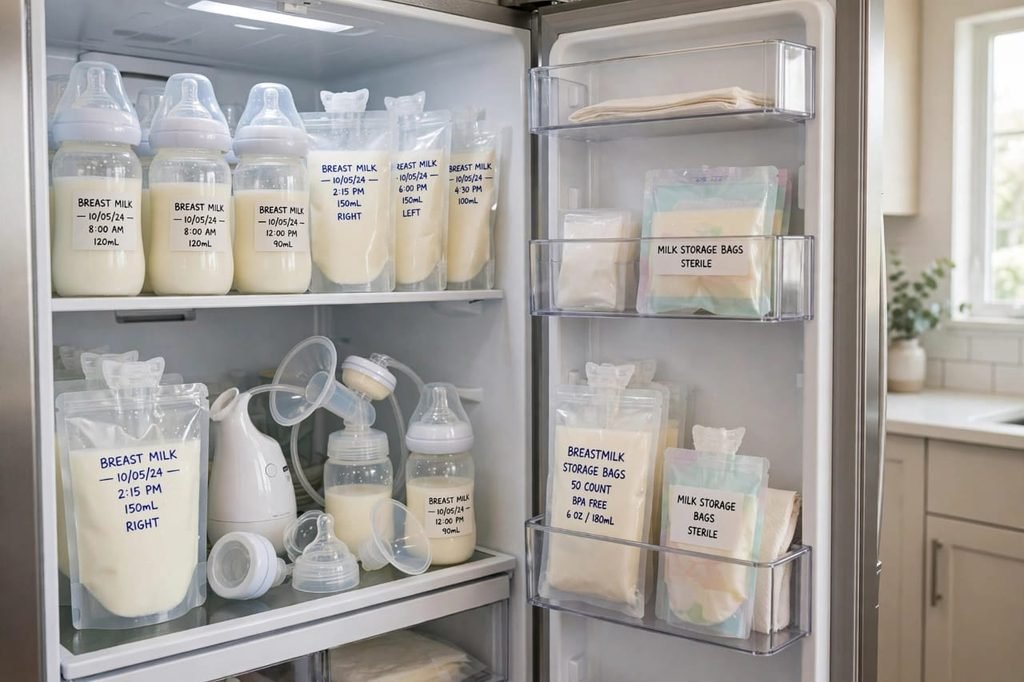
How to Store Expressed Milk Safely
Storing milk correctly is just as important as pumping it. Here is the simple rule that every mom should remember: Rule of 4s
- Room Temperature (up to 25C / 77F): Up to 4 hours
- Fridge (4C / 39F): Up to 4 days
- Freezer (-18C / 0F): Up to 6 months, best within 4 months
Storage Tips That Save Your Milk:
- Always use clean, BPA-free bottles or breast milk storage bags.
- Write date and amount on every bag. Use oldest milk first.
- Never mix fresh warm milk with cold milk. Cool it first.
- Never refreeze thawed milk.
- Thaw frozen milk in fridge overnight, or in warm water. Never microwave it, it destroys nutrients and creates hot spots.
- Smell and taste: Thawed milk may smell a little soapy due to lipase. It is still safe. Most babies drink it happily.

Signs Your Baby Is Getting Enough Milk
Stop counting every ml and watch your baby instead. These signs are more powerful than any calculator:
Positive Signs:
- 6+ wet diapers per day after day 4
- 3-4 soft yellow poops per day in first month
- Baby is calm and satisfied after feed
- Baby gains weight steadily
- Baby is alert and active when awake
- Your breasts feel softer after pumping or feeding
Warning Signs – Call Your Pediatrician If:
- Less than 4 wet diapers per day
- Baby is always sleepy and hard to wake for feeds
- Baby cries inconsolably after every feed
- No weight gain for 2 weeks
- Dark yellow urine or hard dry stools
- Baby has sunken soft spot or dry lips
Trust your instincts. You know your baby better than anyone.
Common Mistakes Moms Make With Expressed Milk
- Overfeeding with Bottle: Bottle feeding is faster than breast. Baby may drink too much too fast. Use paced bottle feeding – hold bottle horizontal, take breaks, let baby pause. This prevents overfeeding and gas.
- Forcing Baby To Finish Bottle: If baby turns head away, closes mouth, or pushes bottle, stop. Forcing leads to spit-up and fussiness.
- Comparing With Other Babies: Your friend’s baby may drink 180ml, yours drinks 120ml. Both can be normal. Focus on your baby’s growth curve, not someone else’s bottle.
- Giving Too Much Water: Babies under 6 months do not need water. Breast milk has all the water they need, even in summer.
- Worrying About Every Drop: One bad pumping session does not mean your supply is gone. Stress lowers supply. Drink water, rest, and try again.
How To Increase Expressed Milk Supply – 7 Powerful Tips
If you feel your supply is low, try these proven tips:
- Pump More Often: Add one extra power pumping session – pump 20 min, rest 10, pump 10, rest 10, pump 10.
- Drink More Water: Aim for 2.5 to 3 liters per day. Keep a big bottle near your pumping station.
- Eat Well: Oats, fenugreek, almonds, and leafy greens are known as galactagogues. They may help some moms.
- Skin-to-Skin: Hold baby close while pumping. Look at baby’s photo or smell baby’s clothes. It triggers letdown.
- Massage Before Pumping: Gentle breast massage for 2 minutes increases output.
- Sleep: I know, it is hard. But even one good nap helps milk production.
- Check Pump Parts: Old valves and membranes reduce suction. Replace every 2-3 months.
You are not a machine. Some days you pump 150ml, some days 60ml. That is normal. You are still an amazing mom.
Expressed Milk vs Formula – Which Is Better?
Expressed breast milk is always the first choice because it has live antibodies that protect your baby from infections, it changes as per baby’s age, and it is easier to digest.
But if you need to supplement with formula sometimes, that is okay too. Fed is best. A combination-fed baby who is loved and thriving is far better than a stressed mom who feels like a failure.
Never let anyone shame you. You are doing your best.
When To See a Doctor
Call your pediatrician immediately if:
- Baby refuses to feed for 8+ hours
- Baby has fever over 100.4F (38C) under 3 months
- Baby is dehydrated – no tears, dry mouth, no wet diaper for 6 hours
- Blood in stool or vomit
- Baby loses weight after first week
It is always better to ask than to worry alone.
Conclusion
So, how much expressed milk does a baby need? In simple words, about 150ml per kg per day, divided into 6-8 feeds, up to a maximum of 900ml per day.
But the real answer is: Watch your baby, not just the bottle. If baby is gaining weight, having wet diapers, and smiling after feeds, you are doing it perfectly.
Pumping is one of the hardest jobs in motherhood. It takes time, patience, and so much love. If you are reading this at midnight with a pump in your hand, know this – you are a superhero mom.
Save this article, share it with a new mom who needs it, and remember, you have got this.
FAQs – Frequently Asked Questions
How much expressed milk does a 1-month-old need?
A 1-month-old baby usually needs 90-120ml per feed, 7-9 feeds per day, total 600-800ml per day.
How much expressed milk does a 3-month-old need?
A 3-month-old usually needs 120-150ml per feed, 6-8 feeds per day, total 720-900ml per day.
How much expressed milk should I leave for 8 hours?
Leave 3 bottles of 90-120ml each, total 270-360ml, plus one extra backup bottle.
Can I overfeed my baby with expressed milk?
Yes, bottle feeding can lead to overfeeding if done too fast. Use paced bottle feeding, hold bottle horizontal, and stop when baby shows fullness signs.
How long does expressed milk last in fridge?
Expressed milk lasts up to 4 days in fridge at 4C, up to 4 hours at room temperature, and up to 6 months in freezer.
Does pumping reduce milk supply?
No, pumping regularly increases supply. Skipping pumps for long hours can reduce supply.
How much expressed milk does a newborn need in first day?
On day 1, a newborn needs only 5-7ml per feed, which is colostrum. It is enough for their tiny stomach.
Can I mix expressed milk from different pumping sessions?
Yes, but cool the fresh milk in fridge first, then mix with already chilled milk from same day. Do not add warm milk to cold milk.