Every new parent does it. You stare into those tiny, perfect eyes in the hospital, or in the first photo at home, and you whisper, “They have my eyes.” Or maybe, “They have your eyes.” And then, a few weeks later, you look again and think, wait, did they change?
If you are wondering, can baby eye colour change, the short answer is yes. For most babies, it absolutely can. And it does, more often than you might think.
In fact, the eye colour your baby is born with is rarely the final colour. It is more like a first draft. The real colour slowly reveals itself over the first year of life, and sometimes even longer.
👶 Baby Eye Colour Calculator
Select parents eye colour and see prediction!
* This is an estimate based on genetics. Actual colour may vary.
I have seen so many parents get confused, excited, or even a little worried about this. One mum told me her baby was born with bright blue eyes, and by nine months they were deep brown. Another dad was convinced his daughter would keep her grey eyes, and then they turned hazel-green. Both were completely normal.
So let us talk about it properly, like a real parent to parent conversation. No scary medical language. Just what actually happens, why it happens, when it stops, and when you should actually worry.
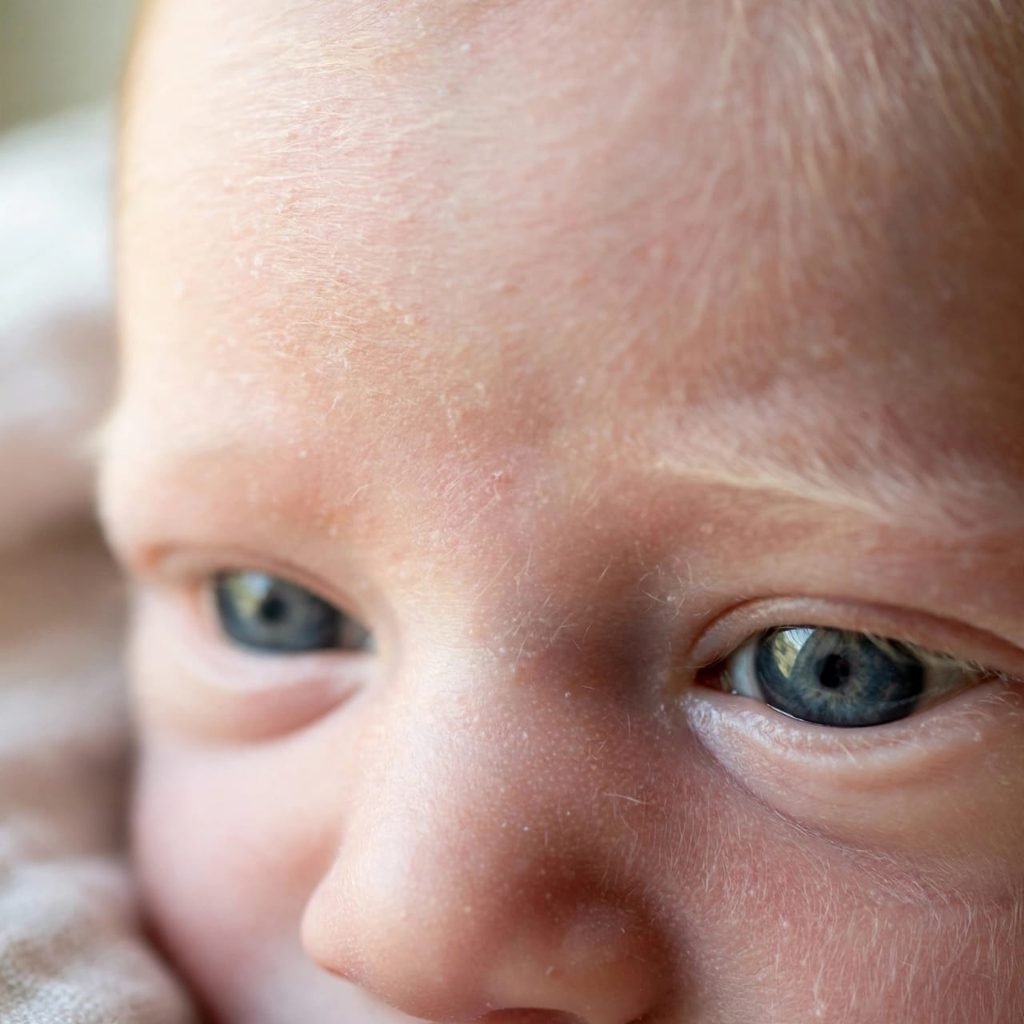
Table of Contents
Why Are Most Babies Born With Blue or Grey Eyes?
This is the part that surprises almost everyone.
Most babies, no matter what their family background is, are born with blue, grey, or slate-coloured eyes. Even babies who will later have dark brown eyes often start out looking blue-grey.
Why? Because of melanin.
Melanin is the same pigment that gives colour to our skin and hair. In the eye, melanin lives in a front layer of the iris, which is the coloured part of your eye. At birth, a baby has not yet produced much melanin in the iris.
Think of it like this. The iris is like a curtain. At birth, the curtain is very thin and light, so light passes through it and scatters, and it looks blue or grey. As the baby grows, the body starts to make more melanin, the curtain gets thicker and darker, and the true colour starts to show.
It is not that the eyes were “fake blue” and then changed. It is that the colour was still developing.
Babies are born with underdeveloped melanocytes, which are the cells that make melanin. Light triggers those cells to start working after birth. That is why the change does not happen in the womb, but in the first months of life outside.
This is also why premature babies sometimes show colour change a little later. Their melanocytes just need a bit more time.
What Actually Makes Eye Colour?
Your baby’s final eye colour is decided by two things working together: genetics and melanin amount.
Genetics is the blueprint. Melanin is the paint.
If there is a lot of melanin in the front layer of the iris, the eyes look brown or dark brown. If there is a medium amount, they look hazel or green. If there is very little melanin, they look blue or grey.
Green and hazel eyes are fascinating because they are not just one colour. They are a mix of melanin plus the way light scatters in the eye. That is why a hazel eye can look green in sunlight and brown indoors. It is not your imagination, it really does shift.
Here is a simple way to remember it:
- Low melanin: Blue, grey, light blue
- Medium melanin: Green, hazel, light brown
- High melanin: Dark brown, almost black-brown
But genetics is not as simple as “brown + blue = brown.” There are at least 16 different genes involved in eye colour, with OCA2 and HERC2 being the two biggest players. That is why two brown-eyed parents can sometimes have a blue-eyed child, and why siblings can have completely different eye colours. Your family tree is full of surprises.
When Does Baby Eye Colour Change?
This is the question every parent Googles at 2 a.m.
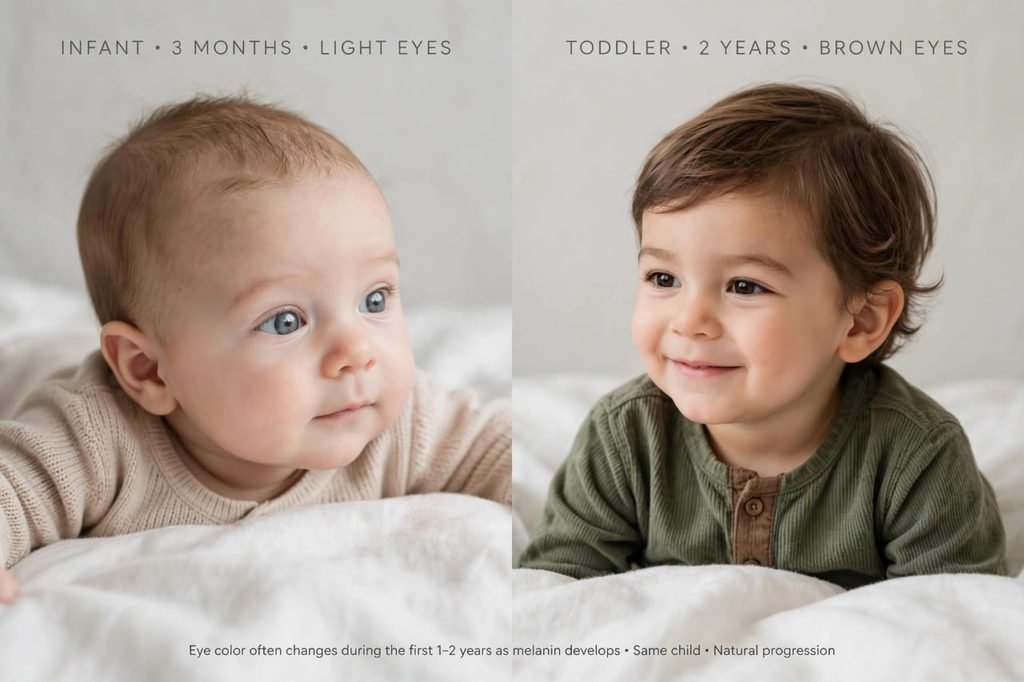
For most babies, the biggest change happens between 3 and 9 months. You might notice it gradually. One week the eyes look a bit more golden. A few weeks later, you see flecks of brown or green around the pupil. Then slowly, the whole iris starts to darken.
Here is a general timeline that most pediatricians agree on:
At Birth to 1 Month: Most babies have blue-grey or dark grey eyes. It is hard to tell anything yet.
1 to 3 Months: Melanin production starts. The colour may start to deepen very slightly.
3 to 6 Months: This is the biggest change window. If your baby’s eyes are going to turn brown, you will usually start seeing it now.
6 to 9 Months: The colour becomes much clearer. Many babies are close to their final colour by now.
9 to 12 Months: For about 80% to 90% of babies, the eye colour is now set, or very close to it.
1 to 2 Years: Some babies, especially those with green, hazel, or light brown eyes, continue to change subtly until age 2 or even 3. It is slower, but it still happens.
Can Baby Eye Colour Change From Blue to Brown?
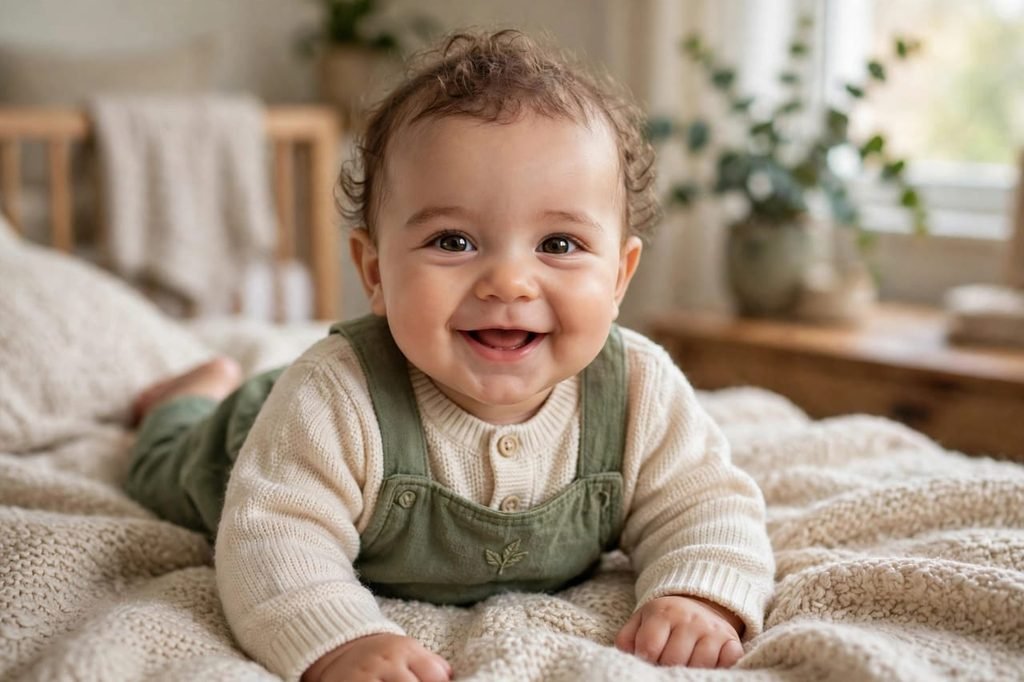
Yes, and this is the most common change of all.
Blue to brown is a one-way street in most cases. It happens because melanin is increasing. Once that melanin is there, it does not go away.
So if your baby was born with blue eyes, and at 5 months you start seeing brown flecks, there is a very good chance those eyes are heading toward brown or hazel. It will not go back to pure blue.
This can be a little emotional for some parents. I remember one mum saying, “I fell in love with those blue eyes, I don’t want them to go.” That is completely normal to feel. But remember, you are not losing anything. You are just seeing who your baby really is.
On the other hand, can baby eye colour change from brown to blue? This is very, very rare. Once a baby has dark brown eyes at birth, they almost always stay brown. If a dark-eyed baby suddenly looks lighter, that is something to get checked, because it is not part of the normal melanin process.
Can Baby Eye Colour Change From Brown to Green or Hazel?
This is less common, but it does happen.
Sometimes a baby is born with dark grey-brown eyes that look brown in photos, but as light hits the iris differently and melanin distributes, the eyes settle into hazel or green. This usually happens in families where there is a mix of green, hazel, and brown eyes.
Hazel eyes are often the last to settle. A hazel-eyed child might look brown at 6 months, green at 12 months, and then a mix of both at 2 years. Parents often think the colour is “still changing” because it looks different in every photo. In a way, it is. Hazel eyes are chameleons.
The Role of Genetics: What Colour Will My Baby Have?
Let us be honest, this is the fun part. Everyone wants to predict it.
If both parents have brown eyes, there is about a 75% chance the baby will have brown eyes, but there is still a chance of green or even blue if both parents carry the recessive gene.
If one parent has blue eyes and the other has brown eyes, the baby has about a 50/50 chance of brown or blue, with a smaller chance of green or hazel.
If both parents have blue eyes, there is about a 99% chance the baby will have blue eyes, but even then, a tiny 1% chance of something else exists because genetics is never 100% simple.
What about grandparents? They matter too. That blue-eyed grandmother from two generations ago can absolutely show up in your baby. Genes can skip a generation. That is why family photos are so fun to look at during this time.
You can use an eye colour calculator as a fun guide, but please treat it as a guide, not a guarantee. It can give you a probability, but it cannot tell you the future. Your baby will decide that on their own.
The Positive Side: Why This Change Is Actually Beautiful
Let us talk about the good stuff first.
First, it is a sign that your baby is developing normally. Melanin production is part of healthy development. When you see those eyes darkening, it means the body is doing exactly what it is supposed to do.
Second, it gives you a chance to watch your baby become themselves. Those first months are all about discovery. First smile, first laugh, first roll, and yes, first real eye colour.
Third, it is a beautiful connection to family. When your baby’s eyes finally settle and you see your mother’s eyes, or your partner’s eyes, or even your own eyes looking back at you, it is a powerful moment. Many parents say it is the first time the baby really “looks like family.”
And honestly, there is no bad eye colour. Brown eyes are warm and deep. Blue eyes are bright and striking. Green eyes are rare and magical. Hazel eyes are unique in every light. Whatever colour your baby ends up with, it will suit them perfectly because it is theirs.
The Negative Side and The Worries Parents Have
Now, let us be real. Not everything about this is fun.
The biggest negative is the uncertainty. You take a hundred photos, and in every photo the eyes look different. One day they look blue, next day grey, next day green. It can be frustrating. You just want to know.
Another worry is comparison. You see another baby on Instagram with bright blue eyes at 8 months, and you wonder why yours changed. Or your mother-in-law says, “Oh, his eyes were so blue, what happened?” That comment can sting, even if it is not meant badly.
Some parents also worry about myths. You might hear things like, “If you feed the baby this food, the eyes will stay blue,” or “If you keep the baby out of sunlight, the eyes will stay light.” None of that is true. Please do not try to change your baby’s eye colour with food, light, or drops. It does not work, and some of those “tricks” online are actually dangerous.
And there is a small, but important, negative side: sometimes a sudden change in eye colour after age 1 can be a sign of a health issue. That is rare, but you need to know it.
Myths About Baby Eye Colour You Should Stop Believing
There are so many myths online, let us clear a few up:
Myth 1: Sunlight makes eyes darker.
Sunlight triggers melanin production, but it does not decide the final colour. Keeping your baby indoors will not keep their eyes blue, and taking them outside will not make them brown. Genetics decides it.
Myth 2: Food can change eye colour.
No food, vitamin, or milk can change eye colour. Honey, carrots, or special formulas do nothing for the iris. Please do not put anything in your baby’s eyes.
Myth 3: Eye colour drops work for babies.
Absolutely not. Those viral eye colour changing drops are unsafe, especially for babies. They can cause infection, glaucoma, and permanent damage. Never use them.
Myth 4: If eyes are blue at 6 months, they will stay blue.
Not necessarily. Some babies keep changing until 12 months or even later. Six months is too early to be sure.
Myth 5: Two different coloured eyes means something is wrong.
Most of the time, it is just uneven melanin development and it evens out. But if the difference is very obvious and stays, it is worth mentioning to your pediatrician. It is called heterochromia, and it is usually harmless and beautiful.
When Should You See a Doctor?
In 99% of cases, baby eye colour change is completely normal and you do not need to do anything.
But see your pediatrician if you notice any of these:
- One eye changes colour suddenly, but the other does not, after age 1
- The eye colour becomes much lighter after being dark
- The pupil looks white or cloudy in photos
- The baby seems to have trouble seeing, does not follow toys, or squints a lot
- The eyes are constantly watery, red, or sensitive to light
- You see a white spot or a strange reflection in the eye
These are not normal colour changes. They could be signs of something like cataract, glaucoma, or another eye condition that needs early treatment. Trust your gut. If something feels off, get it checked. It is always better to ask and be told “it is normal” than to wait.
How to Track Your Baby’s Eye Colour Change
Here is a simple, human way to do it that actually works:
Take a photo in the same natural daylight, near a window, once a month. No flash, no filters. Flash makes eyes look lighter or red, and filters lie.
Look at the outer edge of the iris. That is where the final colour often shows up first. If you see a darker ring forming, that is a clue the eyes are darkening.
Do not compare photos from different lighting. A baby with hazel eyes can look blue in bright light and brown in a dim room. Same baby, same eyes, different light.
And most importantly, enjoy it. This is a once-in-a-lifetime change. You will never get to watch it happen again.
What If My Baby’s Eyes Stay Blue?
Some babies do keep their blue eyes. That is also normal.
If your baby still has blue eyes at 12 months, there is a very high chance they will stay blue. Blue eyes mean low melanin, and if melanin has not increased much by one year, it probably will not increase a lot later.
Blue-eyed babies are more common in families with Northern European, British, or Scandinavian ancestry, but they can appear in any family. And yes, they are beautiful, but so are brown eyes. Your baby does not need blue eyes to be beautiful.
Final Thoughts From One Parent to Another
So, can baby eye colour change? Yes. It can, it often does, and it is one of the most normal, natural parts of growing up.
Your baby’s eyes are not just a colour. They are the way your baby will see the world for the rest of their life. They will see your face, their first toy, their first birthday cake, their first day of school, all through those eyes.
Whether they end up blue, brown, green, hazel, or grey, they will be perfect because they are your baby’s.
So stop stressing about the final colour. Take the photos. Enjoy the change. And when those eyes finally settle, you will know. You will look at them and think, yes, that is my baby.
FAQs
Can baby eye colour change after 1 year?
Yes, it can, but it is slower. Most major changes happen before 1 year, but subtle changes in green, hazel, and light brown eyes can continue until age 2 or 3. After age 3, the colour is usually permanent.
When do babies eyes change colour?
Most babies start to change between 3 and 6 months, with the biggest change happening by 9 months. By 12 months, most babies have their final or near-final colour.
Can a baby be born with brown eyes and then turn blue?
No, this is extremely rare. Brown eyes have high melanin, and melanin does not decrease naturally. If a baby’s dark eyes become much lighter, see a pediatrician to rule out any eye issue.
Do both eyes change at the same time?
Usually yes, but sometimes one eye changes a little faster than the other. This is normal in the first few months. If the difference is very big and does not even out, mention it at your next check-up.
Can grandparents eye colour affect baby eye colour?
Yes, absolutely. Eye colour genes can skip a generation. A grandparent’s blue or green eyes can appear in a grandchild even if both parents have brown eyes.
Is it normal for baby eyes to look different in different lights?
Yes, 100% normal. Especially for hazel, green, and light brown eyes. Bright sunlight makes them look lighter, indoor light makes them look darker. It is not a real change, just light.
Can I predict my baby’s final eye colour?
You can estimate it with genetics and family history, or use an eye colour calculator for fun, but no one can predict it with 100% accuracy. The only sure way is to wait and watch.
Should I worry if my baby’s eyes are still changing at 18 months?
No, not if the change is gradual and both eyes are changing together. Some hazel and green eyes take longer. Only worry if there is a sudden change, pain, or vision problems.